Wednesday, April 9, 2014

"Did You Find It?"

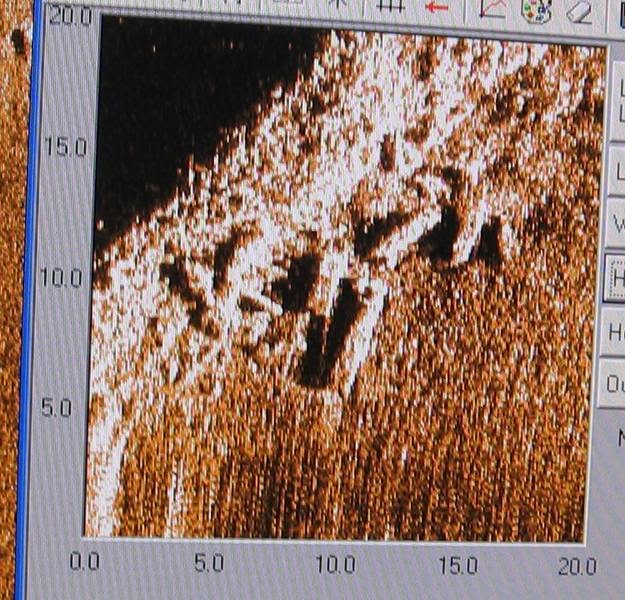
Whenever I return from an expedition, the question I am most frequently asked is "Did you find it?"  My most frequently given answer is “I don’t know.”  Wreck hunting is a multi-phased approach, where you have a particular technology to complete a certain phase of the survey. For example, a sonar survey is Phase One, and on a French Navy minehunter it produces images like this:


Can we tell anything definitive from this image? Not really. We need to gather much more information about it with additional technologies.
Another kind of sonar produces an image like this:


Is it a wreck or rocks?  It's a group of rocks. The two are often so similar that we can’t tell them apart, which brings us to the next phase: target classification. This is done with either a ROV, Autonomous Underwater Vehicle (AUV) or in some fortunate instances, divers.  This image was taken with a ROV:


Again, is it a piece of a wreck or a rock? If we had divers investigate this object, could they determine its identity?  There are no guarantees. This image is actually of a concretion, which is a conglomeration of iron objects that become attached to one another when they are in seawater for a long time. We know this only because we used a magnetometer to detect any metal in the object and it gave off a healthy magnetic signature. That can be another phase, but is ideally combined into with a Phase One sonar investigation. When we finally are able to collect enough definitive evidence about a wreck site, we may be able to say we are onto something.  Until then, we proceed with surveying just in case this wreck is not the one we're after.


Every technological asset we are offered is an expensive gift, and takes a whole team of people to run it, plus a vessel to support the whole operation. Try convincing a Navy to mobilize a ship and crew with a number of specific technologies on board, and you have the makings of a huge challenge. We shoot for the moon, but are grateful for whatever is offered and available. The saying “Beggars can’t be choosers” is applicable here, and there is a constant trade-off between what is needed and what is available.  So we maximize the resources we have on each mission, and appreciate them.  

So did we find it? I don't know. We may have found it as the wreck site we discovered in 2012, but until we have the right equipment to repeatedly investigate that site and prove its identity, we will keep plugging away. This most recent mission was a Phase One and Phase Two approach, with sonar for target acquisition, and a ROV for a very quick investigation of a single target.  Phase Three would be to put divers down on any new sonar targets, including our priority wreck site.  Stay tuned for that, it just may happen!

Thursday, April 3, 2014

Onward and Downward

The Sagittaire is equipped with two underwater robots with cameras, or Remotely Operated Vehicles (ROVs).


They are excellent tools for investigating objects on the seabed if the visibility is good. In the early afternoon, we launch one of them and navigate to our favorite unidentified shipwreck site that was discovered by the French Navy in a 2012 survey. The objective for this dive is to see if the sands have shifted, either burying or unburying parts of the wreck, especially the wooden timbers that lay partially exposed on the seabed:


The ROV is not equipped with a manipulator arm, so we can look, but cannot touch.  For about half an hour, we inspect various (and mostly unidentifiable, except for the large anchor) encrusted objects through the eyes of the ROV.  Then it’s bad news from the Operations team – there is a problem with the ROV’s cable, so the crew recovers it and launches the second one in its place. Within a few minutes, that one gets water in its camera, is hauled back onto the ship, and then both ROVs are pronounced dead. Rumors of a black cat on board begin to circulate. Anyone who works at sea will tell you that equipment breaks more often out here than on land. No one knows why. Maybe the sea gods just aren’t happy with our intrusion into their realm.


Since diving was cut short, we proceed to use the hull-mounted sonar to survey a new area adjacent to the wreck site and search for more potential targets. Until we can prove it, we have to operate under the assumption that the wreck site may not be the remains of the Bonhomme Richard, and we proceed with surveying operations since we have some tremendous assets available to do it.  Besides, we never know what we may discover unintentionally!  

Tuesday, April 1, 2014

How's the Food?

Today dawned bright and beautiful, with calming seas and crisp air, which somehow erased the unpleasant events of the previous night. I woke up to blaring music coming from the ship’s public address system at 7:45, which was the usual wake-up call for the crew.  I stayed out of the way while my three roommates readied themselves ready for work, and then I made my way up to the wardroom for breakfast.

I felt much better and could actually eat, and since we were waiting for the seas to lay down, I thought I would write about the fine French cuisine we were enjoying. Breakfast is very informal, with everyone helping themselves to the cereal, freshly baked bread, juice, coffee and tea that is laid out on the table.  Lunch is more formal and begins with the Commandant and his officers settling onto the wrap-around sofa in one corner of the wardroom. 


Drinks and appetizers (cashews and sausage and cheese) are served, and it is a time for making pleasant conversation before the meal.  Usually we do not discuss work, unless it’s very briefly. Topics of conversation range from food (Do you use the term “French fries” in France? No, they are “Belgium fries”) to travel, to politics, to the adventures of twenty-something males on port calls.  One of the officers says he wants to find the Bonhomme Richard very badly, because he thinks this will secure him an invitation to lunch with President Obama. Another young officer just wants to find a woman to settle down with, and his fellow crewmembers have agreed to help him with this, but no luck so far.


After about 20 minutes, it is announced that the Commandant is served, and we take our seats at the table. I know my place, which is always to the right of the Commandant, and is a place of honor.  Lunch begins with a green salad and warm brie, and always the freshly-baked aromatic French bread.  


The main course is medallions of pork with a white wine cream sauce over vegetables julienne, and I’m so glad I feel well enough to really enjoy it.  


As if all this weren’t enough food, dessert is molten chocolate lava cake drizzled with custard.


Interestingly, the food allotment for French Navy personnel is 4 euros per person per day, whereas in the US Navy, it is $7.00. It is impressive what the French can do for 4 euros. After lunch, we settle back onto the sofa for follow-up coffee or tea, but only for a few minutes until it’s time to get to work.


Dinner time sees the same routine. We are beginning ROV operations after lunch today...

Monday, March 31, 2014

To the Sea...

We leave Edinburgh at 0900 for an 18-hour transit out to the work site.  Nearly all of the crew is out on deck watching the scenery go by. Once in a while I look up and see that I am being observed by various crew members, just out of curiosity, I'm told later and I must quickly get used to being an anomaly. When the ship turns for sea, everyone goes to their stations. I chat with the Scottish harbor pilot who has come aboard to help the crew navigate out of the loch and through the channel into open water. The crew is thrilled that he has also shown them an inshore route home, which should be smoother than their transit from France to Edinburgh.

As soon as we head for open water, I am asked to accompany the Operations Officer to the bridge to review the plan. We talk about the survey and decide to first use the Remotely Operated Vehicle to take a look at our priority wreck site, then use the sonar to survey a block of seabed nearby. It’s possible that there is more of the wreck in the adjacent areas, especially since the region has been trawled.

The forecast is dicey for tonight, good for tomorrow, and then terrible for the rest of the week.  I am surprised that the French Navy would send a minehunter to transit nearly four days, stop in port for three days, then transit another 18 hours, spend 36 hours at the work site, transit two days back to England for a port call, and then finish the several-day trip home to Brest, France.  That amounts to nearly a ten day trip for a day and a half of work if the weather holds, and it is a huge risk with the amount of time and resources involved. But I am grateful for the opportunity and for the continued commitment of France to continue our joint quest.

By later in the evening, the winds pick up significantly, and our transit south is a tough one. In most ships, these seas may not have been problematic, but minehunters are meant for short trips along the coast, and not for working in the open ocean in an extreme environment like the North Sea. They are unstable and roll around even in moderate seas. Here's an image of Sagittaire:


In all the time I've spent at sea on all kinds of vessels, I have been very lucky in that I have been spared the experience of seasickness. Seamen say it can strike even the toughest sailor at any time. My luck ran out on this trip.  During a punishing bout of illness that lasted several hours, I laid down in the Officers’ Wardroom on the sofa because I literally could not make it the two decks down to where my bunk was located (image below).


The smell of liver for dinner certainly didn’t help matters. The toughest part about seasickness is that there is no escape once it hits.  If I was sitting up or standing, any movement of the ship would throw my body off course, a new wave of nausea would strike, and I would swear that every bathroom was miles away. Around midnight, after a few of the longest hours of my life, the medicine I had taken kicked in and I was finally able to get some sleep. ROV operations were planned to start at 3:00 a.m., but I desperately hoped for a stay of execution, as there was no way I could have functioned under the circumstances. The sea state remained unworkable throughout the night, which was good for me, but bad for the mission.

Sunday, March 30, 2014

Expedition 2014 - Of Whiskey and Men

The search for the Bonhomme Richard, ongoing for 8 years now, has grown massively since its inception.  It has become much more than a quest for the remains of an important American war ship. It is an exercise in maximizing assets; it is a test of endurance for people, ships, and equipment; allows for cultural exchange; is used for training in an extreme environment; and is a highly regarded partnership between the U.S. and France.  I write about all of the above, and not just the results of the missions, because all of these things are what makes time spent at sea so valuable and unforgettable. 

Arriving in Edinburgh, Scotland two days before heading to sea on our first expedition of the year proved to be a very wise move for me. I have a hotel room and a large bathtub to luxuriate in before taking on the seas and tiny, moving showers.  It also provides invaluable time to get to know the Commandant and officers of the French Navy’s minehunting vessel Sagitairre, who are enjoying a weekend port call.  We meet for the first time for a tour of Edinburgh Castle. 

We are pleasantly surprised that the Bonhomme Richard and John Paul Jones are mentioned in an audio recording in the prisoners’ barracks, but with Jones being a Scotsman it does make sense that he would find some honor there. These hours together are important because they make us a little more comfortable in that we are no longer unknown to one another, and hopefully some preliminary bonding can occur.  It also gives me a head start on remembering and correctly pronouncing the names of the people whose capable hands my mission is now in. There is a U.S. Navy Exchange Officer with us who is on a two-year tour with the French Navy, and is my project liaison in France.  He is an important part of the mission and as he speaks French and English, eases my transition into French Navy culture, and brings me into the conversations.


Our group of seven men and one woman opt for dinner and drinks at a local pub, and chat as best we can.  Although I am politely invited to tomorrow's pilgrimage to the whiskey distillery at 8:00 a.m. (eek!), I opt to sleep in and spend the day shopping and touring by myself, enjoying some precious alone time before boarding the ship the following morning.  And sometimes men just need to do their man things without a woman tagging along. Speaking of whiskey, this is a common sight in many of the shops.


Tuesday, January 7, 2014

Re-Creating the BHR?

A friend of mine in France just sent me this article that appeared in a French newspaper.  Apparently the mayor of L'Orient, France, who is also Vice-President of the tourism board, would like to build a replica of the Bonhomme Richard to serve as a tourist attraction. What fun that would be! A colleague of mine had originally pitched this idea to the US Naval Academy a few years ago, but I guess it didn't quite catch on. The BHR was built in L'Orient originally as the Duc de Duras, and then when it was loaned to the U.S., it was renamed Bonhomme Richard.  The French have already built a replica of the vessel Hermione, which will be visiting the U.S. next year. It cost 25 million euros to build it.

Here are some images of the BHR model from the article, courtesy of Ouest-France:


I am going to try to contact the mayor and lend my support.  Vive la France!

Wednesday, June 26, 2013

BHR Model Arrives in France

In the April 10 post I mentioned that a model of the BHR was being transported across the Atlantic to France. It has arrived, and is now safely ensconced in a place of honor at the French Naval Academy (Ecole Navale).  A reception honoring this gift from the US Naval Academy was held on June 4 at Ecole Navale.


Here is the French version of events. Translated, it reads:
"On the occasion of Naval History Days, the opening of the model Bonhomme Richard ceremony was held Tuesday, June 4 at the French Naval Academy, under the direction Rear Admiral Philippe Hello and in the presence of U.S. Naval Attache, Captain Robert Buzzell.

Mr. Alain Boulaire, Doctor of History, prefaced this ceremony, gave a lecture entitled "A merchant ship became warship, the example of the Bonhomme Richard," particularly for the benefit of students in the first year at the Naval Academy and students of foreign naval schools present in the context of the international week."

You can read the model's descriptive plaque here.

In other news, our French Navy mission that was scheduled for early July has had to be postponed till later this fall due to the ships' military obligations. This project certainly takes a lot of patience, as it can be months or even a year until we can return to a wreck site to further investigate it.

Sunday, May 19, 2013

News Article and Conforming to Social Media

This week's news is literally...news.  This article appeared in our local newspaper on Friday.

So I took a big leap last week, and finally created a Facebook page for the BHR Project:


I think I am officially old because I had to have my colleague (in her twenties) help me with this. And how do you get everything connected to everyone and everything else once you're in there? I hoped I would never have to go around around saying, "Like us on Facebook!" but here I am. The things we do for love...

My motivations for this are to generate interest in the project, which hopefully then leads to new partnerships and sponsors, the latter being critical right now.  So those of you who are FB experts, I'm counting on you to use your vast networks to help me get the word out!

Sunday, May 12, 2013

Have A Look!

Having recently returned from the first mission of 2013, I wanted to share some encouraging results.  You may recall that at the end of the 2012 mission, the French Navy had located an interesting sonar target that we did not have time to further investigate. Finally, almost a year later, we got a better look at this fascinating site. The first object we identified was this large anchor.

Next was an area of wooden planking (below) that looked like it had recently been unburied, due to the lack of marine life growing on it.  From this, it seems like the colonization rate of marine organisms takes a while (at least a year), since we had seen this planking on the sonar last year, so it must have been exposed even then.

Given that I am a marine biologist by training, I'm sometimes more interested in the stuff growing on the shipwrecks, as well as the critters that call the wrecks home. (And yes, sometimes we get distracted and will follow a lobster around for a minute.)

The weird-looking lump below is actually a concretion, which is a combination of rust, shell, marine organisms, calcium carbonate, and other materials that form a layer around iron objects as the iron oxidizes and reverts back to its natural state.  Concretions are usually more irregularly-shaped than rocks, and this one gave a spike in the magnetometer data.  I might have been seeing what I want to see, but upon closer inspection it looked to me like there were cannonball shapes in this one.


Perfectly linear shapes in nature are rare. That's why we always hear that when someone is stranded on a deserted island, they make patterns or spell out words in the sand to indicate to aircraft that there are humans present. We apply the same theory beneath the sea, and look for things that appear unnatural in the seabed. The image below is of another likely concretion hiding some man-made object:


This white soft coral is most often the best clue to indicate buried objects. In the image below, there appears to be a long length of wood buried just under the surface, so there is more to this site than meets the eye. It is a mostly buried wooden shipwreck with some iron objects present.

So...in the thousands of sonar targets, and dozens of actual wrecks we've seen in 600 square miles of seabed over the past eight years, we've not seen anything with characteristics that even come close to the ones expressed by this site.  If we could just figure out if cannons are present (buried or concreted and not easily identifiable), we could be on our way to something huge.  If anyone reading this blog has access, or knows someone who has access to Autonomous vehicles with magnetometers, or reliable sub-bottom imagery technology, etc. please let me know (melissa.oceantechnology@gmail.com).

We have a summer expedition planned to learn more. The Ocean Technology Foundation's ability to successfully manage and lead this search has been made possible by our wonderful donors and a lot of in-kind support, but we need support now more than ever.  When we are able to prove that we've found the Bonhomme Richard, there will be opportunities for major publicity for our sponsors, and it will all happen fast!  Join us in this great maritime quest and become a sponsor!


Wednesday, April 10, 2013

AQUITAINE

I recently had the great pleasure of being invited to a reception on board the new French Navy frigate AQUITAINE. It was in port visiting Norfolk, VA this past weekend. The ship is unique in that it is state-of-the-art technology and where normally a crew of 300 would be necessary, it needs only a crew of 94.  It was very impressive, both visually and capability-wise. When we stopped at the gate to get on the Navy base, we were told to "just look for the ship that looks totally different than a US Navy ship."

The AQUITAINE is going to transport a model of the BONHOMME RICHARD that was donated by the US Naval Academy to the French Naval Academy. 

It will deliver the model to Brest, France when it returns home this spring.  The model will be displayed at the French Naval Academy as a symbol of our continuing partnership in the search for BHR.

I was invited to deliver some short remarks during the event, along with Admiral John Harvey (USN ret.) and Tim Disher from the US Naval Academy. The event afforded me the opportunity for formal and public acknowledgement of French Navy support for the ongoing search, which since 2009 has involved seven expeditions, with more than 300 FRN personnel going to sea and many more working shoreside to make it all happen.  What a fantastic evening!

Monday, February 25, 2013

Mighty Ships episode available online

UPDATED:
If you missed the episode of the TV show "Mighty Ships: USNS GRASP" which was about our 2011 Expedition with Navy deep-sea divers, you can download it from iTunes for $2.99 here: https://itunes.apple.com/us/tv-season/usns-grasp/id588041773?i=596640392&ign-mpt=uo%3D4
I am speaking to an undergraduate Maritime History class at the University of Connecticut this afternoon, and am going to pose some challenges for them to discuss regarding 1) ownership of the BHR and 2) the debate over bringing up artifacts or leaving them untouched on the bottom of the sea.  Students usually come up with some great ideas and interesting perspectives, which inspires and invigorates me every time.  Just one of the things I love about teaching!
 

Monday, February 4, 2013

BHR Mission 2011 - on TV!

After a year in the making, and another year airing only in Canada, the 2011 Search for Bonhomme Richard is going global!  It will be featured in an episode of Mighty Ships, called "Mighty Ships: USNS Grasp" which will air on the Smithsonian Channel at:

  • 8:00pm EST Sunday 02/10
  • 11:00pm EST Sunday 02/10
  • 9:00am EST Monday 02/11
If you're not sure whether you have the Smithsonian Channel, use the "Channel Finder" option at the top of their home page:  http://www.smithsonianchannel.com/

You can watch the trailer for the show here: http://www.smithsonianchannel.com/site/sn/show.do?episode=3370276

This mission employed Navy deep-sea divers aboard the US Navy Ship GRASP ("the Navy's Swiss army knife") to investigate targets that were potentially the Bonhomme Richard.  The divers set records on this trip, having completed dives to 233 feet, and very few of them had ever worked in an extreme environment like the North Sea.  The producers did an excellent job of depicting what one of our BHR missions is like (ship problems, big waves, equipment failure, bad storm, adapt and overcome.) 

As one of two women on board with 69 men, it was definitely an experience!  I am deeply indebted to the gallant officer who gave up his room with a private bathroom so that we ladies could live in luxury and privacy (relative terms on a ship). If I were male, I would have been in the 39-man berthing space, which looked like this:

And then there was my secret collection of Navy diver sweatshirt photos, which included this one:

I really wish I had started blogging these missions since the beginning.  Someone should really make a movie out of all this.... James Cameron, where are you?...

Hope you can tune in on Sunday. And for the record, I wasn't crying at the end of the show, I was watching events on deck and looking into the sun, all the while being filmed and not knowing it!  But what's TV these days without things taken out of context and made dramatic?

Thursday, January 10, 2013

Getting the Word Out

New Publication!
In a previous post, I mentioned a new publication I was working on with Admirals Harvey and Demeocq. It has now been published in Marine Technology Society Journal's November/December 2012 issue. It's a Commentary piece titled "Searching for the Bonhomme Richard:  A Tale of Two Navies" and you can read it here: http://www.oceantechnology.org/BHR_Pubs.htm   I am posting it on our web site because the only other way to access it online is if you are a Marine Technology Society member (which I'm guessing a lot of people may not be).  But if you are an MTS member, or wish to become a member, please visit their site here.

2013 Mission
We are still planning for a spring expedition on a ship of opportunity that is based in the U.K. More on that as it develops.

French Navy Event
I'm very excited to be attending an event later this spring when a French Navy ship will visit the port of Norfolk, VA.  Part of the reason for this event is to bring on board a 6-foot-long model of the Bonhomme Richard (below) that will be donated by the US Naval Academy to the French Naval Academy. The French ship will transport the model across the Atlantic to its new home in Brest, FR.  The model will be part of an exhibit at the French Naval Academy which will highlight the importance of our shared maritime patrimony and the important partnership we have built in searching for the BHR.


Sunday, November 11, 2012

Fall 2012 News


Writings
All things BHR-related tend to slow down in the winter, as we wait to see if there will be a 2013 expedition with either the French or US Navy (or maybe both). This is a good time to work on things like publications. I have recently co-authored a commentary piece for a marine technology journal about the importance of the US-FR Navy partnership within the context of the BHR search.  I had the great honor of sharing authorship with Admiral John Harvey, USN (Ret.) (Commander, Fleet Forces Command), and Rear-Admiral Bruno Deméocq (Deputy Commander of the Atlantic Surface Fleet, French Navy) who heads the French BHR efforts.  Both gentlemen have been tremendously supportive of the project for years now, and are in large part responsible for its success and sustainability. I will post a link to our publication as soon as it becomes available, hopefully in a couple of weeks.

The Mighty P3
I’m hearing that there is the possibility for another Orion P3 aircraft mission (see earlier post in this blog) to fly over our search area and complete the survey that was started last spring. (The lady pilot who flew the last mission is a U.S. Naval Academy graduate – yeah!)  If they can do this and fill in gaps in the data previously collected, we could create a magnetic anomaly map of the area.  The iron ballast mound of the BHR might give off enough magnetic signature to show up as an anomaly, but we can’t be sure since we’ve never used the P3 for this type of survey before. I wonder if they’ll take me with them?

The Target
At the end of this year’s mission, I posted sonar images of the two best targets we had found.  After the sonar data was processed and mosaicked (put all the snapshots together to see the big picture), there seems to be more to one of the targets than we originally thought.  In this image, it looks like there is a debris field that measures approximately 25 meters in length and 10-15 meters across.

We are working toward a new collaboration with a private organization which might be able to investigate this target on a special mission a few months from now.

Tuesday, July 24, 2012

In the News

Sometimes there's a delayed reaction with media articles. I was not very proactive in promoting the recent expedition, but I'm glad someone else was.  The Naval Meteorology and Oceanography Command produced a nice article that appeared on the Navy News web site today.  We'll see if it inspires any additional interest from other media folks.

Mine Warfare Group Helps in Search for Bonhomme Richard


Story Number: NNS120723-11Release Date: 7/23/2012 1:08:00 PM

By George Lammons, Naval Meteorology and Oceanography Command Public Affairs

STENNIS SPACE CENTER, Miss. (NNS) -- A four-member crew from the Oceanography Mine Warfare Center (NOMWC) Stennis Space Center, Miss., surveyed 41 nautical miles and had generated 22 contacts for French divers to examine in this summer's expedition to find the remains of the revolutionary warship Bonhomme Richard.

Ensign Vincent Chamberlain, leader of the NOMWC crew, told Rear Adm. Jonathan White, commander of the Naval Meteorology and Oceanography Command (NMOC), in a July 9 briefing that the crew spent May 27 through June 7 surveying the North Sea site of the wreck, part of the multinational, multi-organization effort.

"This was a great opportunity for us to test some new equipment, to train on the equipment in a different environment, to work with the French navy and to help find a historically significant artifact to our navy and our nation," White said.

Bonhomme Richard, captained by John Paul Jones, sank in the North Sea in 1779, following the Battle of Flamborough Head during the American Revolution. Since 2006, the Ocean Technology Foundation (OTF) and its partners have conducted expeditions in the North Sea to try to find the remains of the ship. Naval Oceanography assisted in the last three expeditions in 2010, 2011 and 2012. OTF is an undersea research and education service organization whose activities range from supporting its own projects to developing deep water technologies and research programs. White's command directs the operations of naval oceanography. This year's search was a joint operation with the French navy.

"NMOC allowed for increased productivity in this year's mission with their unmanned underwater vehicle (UUV) and expert team of technicians," said Melissa Ryan, OTF chief scientist and project manager. "The UUV provided detailed, high resolution imagery of 48 targets, and allowed us to determine whether these targets were worthy of further investigation."

The NOMWC group, which operated off the French dive ship, Styx, surveyed with a Remus 100 Unmanned Underwater Vehicle. Remus uses side-scan sonar to image the bottom. Those images reveal objects that could be a remnant of the ship. NOMWC uses Remus the same way to search for mines.

"Our team gained a lot of experience conducting operations from a French dive ship and utilizing deep water transponders for UUV navigation," said Chamberlain.

NOMWC shared the data with OTF for analysis.

For more information, visit www.navy.mil, www.facebook.com/usnavy, or www.twitter.com/usnavy.

For more news from Naval Meteorology and Oceanography Command, visit www.navy.mil/local/cnmoc/.

Thursday, June 14, 2012

Post-Mission Reflections

So…did we find the BHR? I honestly don’t know.  Did we find two potentially interesting cultural sites? It’s very possible.  Will we ever get to find out what they are?  I sure hope so.  But this project is about so much more than cannons on the bottom of the sea.

Someone once told me that sometimes it’s the process that is most important.  This was the fourth collaborative BHR mission between the US and French Navies in as many years.  It was the most complicated one yet, with U.S. teams on all three ships (most of us not knowing how to speak French), a two-way flow of knowledge and experience from all personnel, training for the French crew on the Autonomous Underwater Vehicles, and a joint quest that is a symbol of our nations’ intertwined maritime histories.  It is a quest that belongs to everyone – the interested citizen, the history buff, the donors who support the Ocean Technology Foundation, the men and women who serve or have served in the Navies, and the young student whose interest in marine technology is piqued by reading about the BHR missions.  I advocate for these missions because they are life-altering -- for me, and hopefully for all those involved, even in some small way.

I don’t really know what to do with this blog at this point.  Sometimes it is a matter of months before any other mission-related events occur, but I will continue to post any new as they happen.
The best way to monitor the blog is to sign up for the email option, and you will automatically receive any new posts via email. If you have any questions or comments for me, you can always email me directly at melissa.oceantechnology@gmail.com.  Thanks for sharing this amazing quest!

I want to express my deepest appreciation to the Commanding Officers and Crews of ANTARES, STYX, and LAPLACE, the latter which also hosted an outstanding team of hydrographers from SHOM, the French Hydrographic Office.  Your Admiral gave you this mission because he believed so strongly in each of you. You have tested the limits of your ships in many ways, and I hope they exceeded your expectations.  Know that you are tougher and more determined than you may have thought, having been much farther from home than usual, and having braved the notorious North Sea in vessels not necessarily suited for it.  Know that you are the ones who really made this mission successful. You inspire me, and I will miss you.
To Bruno, John H. and Jon W.:  Many, many thanks for your leadership and unwavering faith in what we are doing. I only wish you could have been out there with us to see first-hand the hundred positive impacts of your support. You have changed lives, and there is more to come...

Wednesday, June 13, 2012

It's Not Over Yet

Thursday, June 7


As usual, the weather forecast was for strong winds and moderate to heavy seas. There was a strong low depression moving over the U.K. and by tomorrow there would be gale force winds. We reminded ourselves that the weather could not be trusted, and the Captain ultimately decided that it would be all right to continue the survey.  All day long, for hour upon endless hour, we looked at images of the seabed and noted some unexciting targets. Again, nothing appeared to be what we would expect of a shipwreck, or at least a pile of half-buried ballast.  Around 2:00 pm, we saw something on the computer screen that looked “different.” Not like rocks, and not like sand waves, but something out of character with its surrounding environment.  It was 15 meters long and 3 meters wide, and had some vertical sections that seemed oddly out of place on the bottom of the ocean (see image below). 
About half an hour later, we spotted another interesting target. This one was smaller, but again looked a lot more interesting than the surrounding seabed.  We don’t know if part of it could have been buried and not visible, as often happens with shifting sands.  But we marked its location and decided we liked it.

It was getting late in the afternoon, and the seas were picking up.  STYX was working several miles from us, preparing for a diving mission, but we radioed them to ask for an AUV mission instead, in order to further investigate these new targets.  The AUV has higher resolution imaging and can fly closer to the seabed than the towed sonar system.  We gave them the coordinates of the targets, and they prepared for their mission, which would begin at 6:00 pm.  It would be the last one of the evening, and if the weather forecast was correct, the last one of the entire mission, which would end a day early.  We had one chance to get more information on these targets.  At 5:00 I spoke with the AUV team and they said that the wave height was borderline for working safely, but they still planned to go ahead with the mission.  At 5:30 I was called to the bridge. The AUV team informed us that they could not carry out their final mission.  The seismic ship that was working in our area was coming through, and both of our ships had to move out of the way. With the weather worsening by the minute, there would be zero chance for another mission, even after the seismic ship cleared the area.  
So that was it.  There is always that one dreaded moment during a mission when I know it just isn’t going to happen this time. And that I have to go back home and tell the Admirals again that the results of the mission are inconclusive.  Could I ramble off a list of excuses?  Sure. Weather, equipment failure, not enough time, etc.  But this is just the nature of the beast, and anyone who has worked in salt water knows and accepts this.  When planning a mission, we automatically take the total number of days of the mission, and assume that we will be able to work for only half of those days.  Mother Nature does not negotiate, and too many other circumstances are beyond our control.

After seven years, I should know better than to feel incredulous and frustrated that a mission ends with more questions, but it still doesn’t get any easier.  Surveying in the North Sea is the ultimate test of endurance – of people, vessels, equipment, and spirit. But I think we all passed with flying colors. Where do we go from here, and most important, what have we learned?

Tuesday, June 12, 2012

Mysterious Rings and Offerings to the Gods

Wednesday, June 6

Last night was the worst night yet, by a mile.  The 27-knot winds were from the southeast, meaning that we could not seek shelter near the shore as we did the previous night.  The ship pitched and rolled all night long, and it was tough just to stay in my bunk.  I took an extra blanket and stuffed it along one side of my bed. With my knees braced against the wall and my back pressed into the blanket, I was able to remain stationary for at least part of the night.  I must have woken up every half hour, hearing the noises of an unstable ship – pots clanging loudly in the galley, doors slamming shut after they worked themselves open, plaques falling off the walls.
I got out of bed at 5:30 since there was no point trying to sleep, and found my way to the bridge. I believe that this is one of the secrets to fighting seasickness, because you can see the swells coming in advance, anticipate the ship’s movements, and adjust your balance accordingly.  The waves were breaking over the bow, and the skies were their usual North Sea grey.  The mood on the bridge could only be described as somber, and the five men on duty were silent and unmoving due to lack of sleep, seasickness, and general misery.  I asked the Executive Officer what they usually do when morale is low, and he said, “Work.”  Since we couldn’t work, I asked what else we could do.  His response was, “I don’t know, morale's never been this bad before.” 

For some humor, I told the crew I was going to make an offering to the sea gods and goddesses, so that they would bring us better weather.  Legend says the gods like sweet things, so I collected some chocolate and fruit, and held a brief ceremony where I made a request and tossed little bits of sweets into the sea (photo left). They thought I was crazy, but I think it may have worked.

A few hours later, in spite of the stormy forecast, the bridge crew began having earnest conversations, and though I couldn’t understand French, I could tell by the feeling in the room that something was happening.  They had noticed the wind speed decreasing, and decided to wait half an hour to see if it would continue declining.  If it did, we could launch the sonar and get back to work.
30 Minutes Later
The mood of a ship changes in an instant, and word traveled fast that we now had an opportunity to work.  There was a tangible excitement in the air as crew members darted through the passageways, giving commands, putting on their gear, preparing to fire up the sonar system and get it in the water.  It was like the fog had lifted, and now there were smiles everywhere. One of the crewmen was whistling the theme song from the movie "Rocky" and it made me smile.
The final word from the Captain was that we were “go for launch,” so the Thales DUBM-44 sonar was deployed (photo top right), and we were off. We surveyed for the rest of the day (sonar command central is on bottom right), but did not find any really compelling targets – only ones that looked like rocks.  In the meantime, the divers on STYX dove on a few targets and described them as “rocks and sand.”  Still nothing solid to pin our hopes on.

Follow Up Note from Last Week: The Rings on the Seabed
Throughout the entire mission, we had been having to give way to a much larger commercial ship that was doing seismic surveys to search for oil in the seabed. In conversation about the target we had seen earlier in the week that consisted of two 35-foot rings, we wondered if these were perhaps some equipment left behind by the seismic ship.  I spoke with the ship’s Captain via the radio, and he indicated that the rings were not related to their work.

So once again, we towed the sonar over the location where we had seen the rings, and were surprised to find that they were no longer visible.  We thought that perhaps these were very large schools of fish who were circling their prey, but I asked a fisherman about this, and he was doubtful the fish would have been schooling that close to the seabed. The other popular theory had something to do with UFOs.  Forget about finding the BHR – I’ll take a UFO discovery any day, or even Atlantis!  But the rings will have to remain a mystery of the deep.

Sunday, June 10, 2012

The Vessels and Monday Activities

At the beginning of this blog, I purposely had not described the vessels we were using, in order to protect their locations, since they are military vessels.  Since they have now moved on to their next missions or are transiting, I am sharing their photos below. Week 1 was spent aboard the 59-meter hydrographic ship LAPLACE (following these links will take you out of the blog, so you will need to hit the Back button to return). Laplace is beautifully equipped for oceanographic survey and mapping.  Its usual missions are mapping the French coast.

Weeks 2 and 3 have been on the STYX and ANTARES.  STYX is a 41-meter dive support vessel with a team of divers and the US Navy Autonomous Underwater Vehicles we are using for target investigation. This past week, I was based on ANTARES, a 28-meter long vessel whose mission is sonar surveying.  The two ships work together in their missions locating and clearing mines along the French coast. The divers are trained to deactivate the mines – not a job I would want.

LAPLACE


ANTARES


STYX


Monday, June 4

We have spent the past two days transiting from the port of Hull, England, and waiting for the weather to improve. Having done no surveying and having nothing new to report search-wise, this post, like some of the others, will focus on life aboard a French Navy ship.
Today I will attempt to describe the hideousness that is an angry North Sea, particularly when you are on a very small ship that is not meant to work in the deeper waters offshore.  I don’t think there is a single one of us who has escaped feeling the effects of literally being pounded into one wave after the next. The sea state is a "5", meaning there are 20+ knot winds and waves of about 4 meters.  We are tossed about, and two people are feeling so crummy that they are lying down outside on the aft deck. The XO has assigned someone to check on them periodically to make sure they are still with us and did not fall overboard. We are getting our butts kicked by Mother Nature once again, and have no chance of winning.  In my brief check on the status of my team of two (the ones lying out on the deck), another crew member runs out the door to the stern and bends over the rail.  I feel so bad for everyone, as they are not used to working in heavy seas. I feel particularly bad for the cook, who wasn’t well and had to continue producing meals for 25 people, while boiling huge pots of water that sloshed about, and with the smell of food permeating the air. Maybe it’s because I have already been out here for two weeks, but I have been spared the seasickness. I will count my blessings and try to keep everyone's morale up as best I can. 

The forecast for the next two days is not good, with the sea state reaching a "6" (4-6 meter waves and very rough seas) by tomorrow.  We talk about heading inshore to the shelter of Flamborough Head, which we have done on previous expeditions.  It seems like an eternity (only a few hours) until we are granted permission from the British authorities to anchor near the shore for the night.  Our companion vessel, STYX, is about 10 hours behind us in the transit, as they had engine trouble in port and had to wait for the next tide in order to sail.  Based on our terrible transiting experience, they chose the inshore route and had a much more comfortable ride up to Flamborough Head, where they moored next to us for the night.  We will travel together to the survey area in the morning, and hope that conditions allow us to continue the survey.  A good night's sleep should do everyone good.

Friday, June 1, 2012

Wrapping Up Week 2

Our week ended a bit early, with a port call Thursday-Monday, so we are in England for the weekend.  Week 2 did not go as smoothly as the first week, but we managed to get some good work done. The sonar system was down the first three days, but valiant attempts by the crew to repair it paid off, and we covered about 13 nautical miles of seabed.  We do not have any spectacular targets, but there is one that is very intriguing - not in that it's the BHR, but we have no idea what it is.  On the sonar, it appears as two perfect large white rings, almost intertwined, and each one is 12 meters in diameter, and about 3 meters thick.  The sonar experts pronounced it "bizarre."  It is within diving depths, so we may check it out. I could not get a good screen capture of it, but hopefully will this week and will share it with you.

I am feeling a little bruised and battered from fighting the movements of the ship in the swells, and trying to constantly maintain balance, but not always succeeding. My daily commute is transfer by zodiac from one vessel to another in order to watch the sonar data coming in, and then going back to the other ship in the evening to see the results from diving and AUV operations. I'm getting to be an expert at putting on the bulky orange jumpsuit that's needed for protection against cold and waves during the transfers. I continue to be impressed with the efficiency of the French Navy - launching and recovering the zodiac takes about 4 minutes, and they do it several times a day.  The divers operate out of zodiacs as well, and each dive takes 4-6 divers in the boat who each get a ten-minute dive.  It is an easier process than I thought and again, very efficient.

Morale was getting a little lower than normal with the heavy swells and difficulty sleeping, and everyone was working very hard, so....it was time for a barbeque on deck with sausages, lamb chops, pasta salad, melon, appetizers, and ice cream bars for dessert.  The Captain and several crew members from the sonar ship came over to join us as well.


Next week I'll be living on the small sonar ship, since I spent this week on the dive support ship, and I want to get a feel for all operations, and get to know as much of the crew as possible.  This mission is unusual for all involved, because they usually conduct missions for 2-3 days, and stay a lot closer to home in Brest, FR.  It's just another very special aspect of this adventure!